Sunday, 29 January 2017

Nearly half of breast cancer patients have severe treatment side effects

Nearly half of breast cancer patients have severe treatment side effects
Many women being treated for breast cancer suffer from severe treatment side effects even when they don’t receive chemotherapy, a recent study suggests.
For the study, researchers surveyed 1,945 women diagnosed with early-stage breast cancer about the severity of seven treatment side effects: nausea and vomiting, diarrhea, constipation, pain, arm swelling, shortness of breath and breast skin irritation.
Overall, 45 percent of participants reported severe or very severe forms of at least one of these side effects. When women got chemotherapy, the odds of severe side effects were twice as high, though the side effects were just 30 percent more likely when chemo was paired with radiation.
“We did know that some of these side effects were associated with these treatments, but we did not know how severe or how common these side effects were,” said study co-author Dr. Allison Kurian, a researcher at Stanford University School of Medicine in California.
“I found it striking that nearly half of all women treated for early-stage breast cancer reported suffering toxicity that they considered severe or very severe,” Kurian added by email. “This emphasizes the prevalence and seriousness of the problem.”
Early-stage breast cancer is the most common type of invasive breast cancer diagnosed in the U.S, and it involves smaller tumors that may have spread to nearby lymph nodes but not other parts of the body.
Most early-stage breast cancer patients have surgery – either a lumpectomy that removes malignant tissue while sparing the rest of the breast or a mastectomy that removes the entire breast. After surgery, they may also get chemotherapy or radiation to destroy any remaining abnormal cells and reduce the risk of cancer coming back.
Overall, 93 percent of the women in the study experienced at least one of the seven side effects, researchers report in the journal Cancer.
Nearly one in 10 women surveyed said they made at least one unscheduled clinic visit because of side effects, and 5 percent said they went to an emergency department or hospital.
Severe swelling in the arm or skin irritation were the most common reasons for unscheduled clinic visits. Severe breathing difficulties, arm swelling, pain or diarrhea were the most common side effects that brought women to the hospital.
Most patients in the study got some type of surgery and about half of them had radiation. There were 736 women who had chemotherapy, including 217 who received this in addition to radiation.
About 29 percent of chemotherapy patients reported severe or very severe pain, compared with 19 percent of women who didn’t receive chemo.
Women who had both chemotherapy and radiation treatment were 30 percent more likely to report a severe side effect, compared to women who had only one of those treatments.
Women who had double mastectomy were twice as likely as those who had lumpectomy to report severe or very severe pain.
Severe side effects were also more common for Latina women, who were 30 percent more likely than white women to report a severe or very severe side effect.
The study wasn’t a controlled experiment designed to prove that certain treatments directly cause specific severe side effects, the authors note. Researchers also lacked data on the timing or dosing of chemotherapy and radiation, both of which can influence the severity of side effects.
“It is intuitive that patients who have worse disease, and who therefore require more therapy, experience worse toxicity,” said Dr. Anees Chagpar, a researcher at Yale University in New Haven, Connecticut, who wasn’t involved in the study.
Still, the results should encourage doctors to consider when patients' treatment regimens might be able to achieve the same survival benefit with fewer side effects, Chagpar added by email.
“The treatments we have for cancer are very effective, but there is a growing recognition of the ‘collateral damage’ that can accompany these treatments,” said Dr. Shelley Hwang, a researcher at Duke University in Durham, North Carolina, who wasn’t involved in the study.
“Patients should recognize two things: first, that cancer treatments involve trade-offs; second, that some toxicities can be long-lasting,” Hwang added by email.

Saudi king agrees in call with Trump to support Syria, Yemen safe zones: White House

Saudi king agrees in call with Trump to support Syria, Yemen safe zones: White House
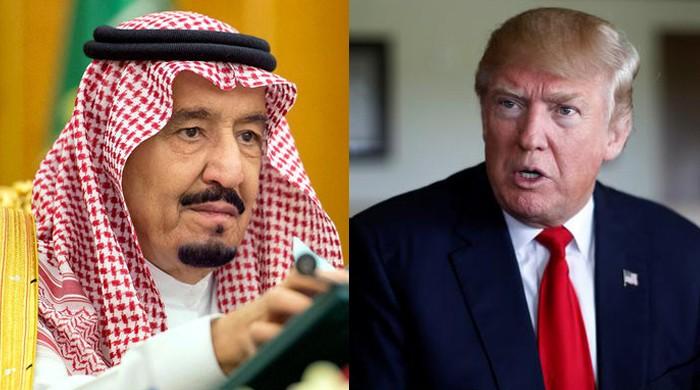
WASHINGTON: Saudi Arabia's King Salman, in a phone call on Sunday with U.S. President Donald Trump, agreed to support safe zones in Syria and Yemen, a White House statement said.
Trump, during his presidential campaign last year, had called for Gulf states to pay for establishing safe zones to protect Syrian refugees.
A statement after their phone call said the two leaders agreed on the importance of strengthening joint efforts to fight the spread of Islamic State militants.
"The president requested and the King agreed to support safe zones in Syria and Yemen, as well as supporting other ideas to help the many refugees who are displaced by the ongoing conflicts," the statement said.
They also agreed on the need to address "Iran's destabilizing regional activities," the statement said.
It said the two also discussed what it called an invitation from the king for Trump "to lead a Middle East effort to defeat terrorism and to help build a new future, economically and socially," for Saudi Arabia and the region.

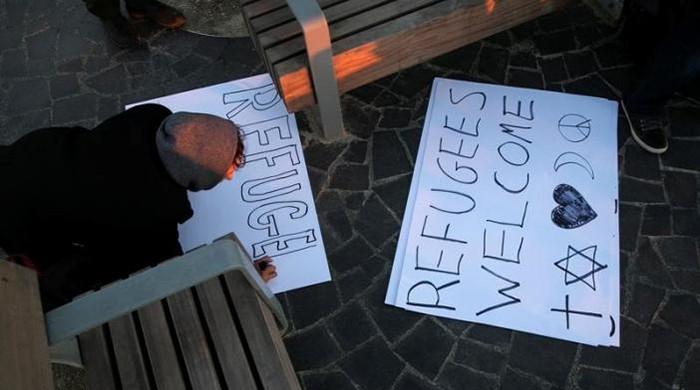
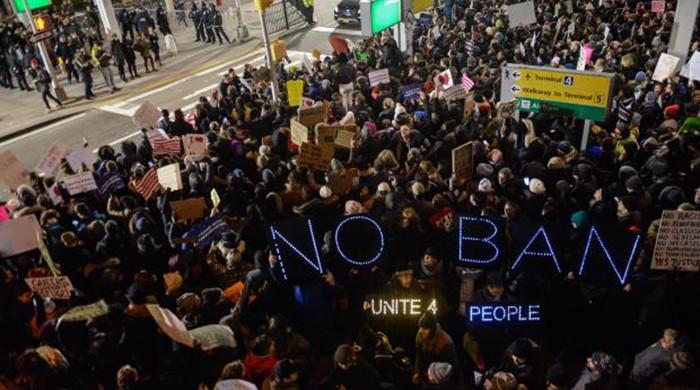
Global backlash grows against Trump's immigration order

Global backlash grows against Trump's immigration order


BAGHDAD/CAIRO: A global backlash against US President Donald Trump's immigration curbs gathered strength on Sunday as several countries including long-standing American allies criticized the measures as discriminatory and divisive.
Governments from London and Berlin to Jakarta and Tehran spoke out against Trump's order to put a four-month hold on allowing refugees into the United States and temporarily ban travelers from Syria and six other Muslim-majority countries. He said the move would help protect Americans from terrorism.
In Germany - which has taken in large numbers of people fleeing the Syrian civil war - Chancellor Angela Merkel said the global fight against terrorism was no excuse for the measures and "does not justify putting people of a specific background or faith under general suspicion", her spokesman said.
She expressed her concerns to Trump during a phone call and reminded him that the Geneva Conventions require the international community to take in war refugees on humanitarian grounds, the spokesman added.
Merkel's sentiments were echoed in Paris and London; "Terrorism knows no nationality. Discrimination is no response," said French Foreign minister Jean-Marc Ayrault, while his British counterpart Boris Johnson tweeted: "Divisive and wrong to stigmatize because of nationality."
Along with Syria, the US ban of at least 90 days affects travelers with passports from Iran, Iraq, Libya, Somalia, Sudan, Syria and Yemen, including those with dual nationality that includes one of those countries.
Trump said his order, which indefinitely bans refugees from Syria, was "not a Muslim ban", though he added he would seek to prioritize Christian refugees fleeing the country.
The Arab League - whose members include many of the countries included in the ban as well as allies of Washington such as Saudi Arabia, Egypt and Jordan - expressed deep concern and said the restrictions were unjustified.
The government in Iraq, which is allied with Washington in the battle against ultra-hardline Daesh group and hosts over 5,000 US troops, did not comment on the executive order.
But some members of its parliament said Baghdad should retaliate with similar measures against the United States.
IRAN VOWS TO RESPOND
In Baghdad, influential Shi'ite cleric Moqtada al-Sadr said American nationals should leave Iraq, in retaliation for the travel curbs.
"It would be arrogance for you to enter freely Iraq and other countries while barring to them the entrance to your country ... and therefore you should get your nationals out," he said on his website.
There was no immediate reaction to the curbs from Daesh, although in the past it has used US monitoring of Muslim foreigners to stoke Muslim anger against Washington.
The Tehran government vowed to respond in kind to the US ban on visitors from Iran, but on Sunday Foreign Minister Mohammad Javad Zarif said on Twitter that Americans who already hold Iranian visas can enter the country.
"Unlike the US, our decision is not retroactive. All with valid Iranian visa will be gladly welcomed," Zarif said.
Authorities in Sudan, which is also targeted by the ban, summoned the US charge d'affaires in Khartoum. They said the order sent a "negative message", coming two weeks after Washington announced it would ease economic sanctions on the country.
Trump's executive order on Friday took effect immediately, wreaking havoc and confusion for would-be travelers with passports from the seven countries and plunging America's immigration system into chaos.
The Department of Homeland Security said about 375 travelers had been affected by the order, 109 of whom were in transit and were denied entry to the United States. Another 173 were stopped by airlines before boarding.
Fuad Sharef, his wife and three children were among the first victims. They had waited two years for a visa to settle in the United States, selling their home and quitting jobs and schools in Iraq before setting off for a new life they saw as a reward for working with US organizations.
They were prevented from boarding their connecting flight to New York from Cairo airport on Saturday, detained overnight and forced to board a flight back to northern Iraq.
'I AM TOTALLY BROKEN'
"We were treated like drug dealers, escorted by deportation officers," Sharef told Reuters, likening Trump's decision to the dictatorship of former Iraqi leader Saddam Hussein. "I am broken, I am totally broken."
A 32-year-old Syrian man, Nail Zain, was among dozens of people at Istanbul's Ataturk Airport prevented from flying to the United States on Sunday. He told Reuters he was supposed to fly to Los Angeles, but officials said his visa was canceled.
"My wife and my son are in the United States. My son has American nationality. And we have been waiting for this moment for two years. Finally when I got the chance, they prevented me as a Syrian passport holder from traveling," he said.
He was later taken out of the terminal by authorities.
Trump, a businessman who successfully tapped into American fears about militant attacks during his campaign, had promised what he called "extreme vetting" of immigrants and refugees from areas the White House said the US Congress deemed high risk.
He said on Saturday of his order: "It's working out very nicely. You see it at the airports, you see it all over."
The travel curbs, however, also drew criticism from several other countries around the globe.
In Jakarta, Indonesian Foreign Minister Retno Marsudi said the Muslim-majority nation deeply regretted Trump's plans for "extreme vetting" of people from some Muslim countries.
Italian Prime Minister Paolo Gentiloni said "open society, plural identity, no discrimination" were the "pillars of Europe", while the Danish, Swedish and Norwegian governments also registered their opposition.
Danish foreign minister Anders Samuelsen tweeted: "The US decision not to allow entry of people from certain countries is NOT fair." 
Canadian Prime Minister Justin Trudeau said his country welcomed those fleeing war and persecution, even as Canadian airlines said they would turn back US-bound passengers to comply with an immigration ban on people from seven Muslim-majority countries.
"To those fleeing persecution, terror & war, Canadians will welcome you, regardless of your faith. Diversity is our strength #WelcomeToCanada," he tweeted.

Attorneys general from 16 states condemn Trump travel ban

Attorneys general from 16 states condemn Trump travel ban
Attorneys general from 16 US states, including California and New York, on Sunday condemned President Donald Trump's executive order on immigration as "unconstitutional" and vowed to fight it.
Two days after the new Republican president halted entry to the US by refugees and persons from seven Muslim-majority countries, the attorneys general, all Democrats whose states nearly a third of the US population, issued a joint statement in opposition.
"As the chief legal officers for over 130 million Americans and foreign residents of our states, we condemn President Trump's unconstitutional, un-American and unlawful Executive Order," read the statement.
The attorneys general pledged to "work together to ensure the federal government obeys the Constitution, respects our history as a nation of immigrants and does not unlawfully target anyone because of their national origin or faith."
Noting that several federal courts had already blocked parts of Trump's order, the attorneys general said they would "use all of the tools of our offices to fight this unconstitutional order and preserve our nation's national security and core values."
They also predicted the courts would ultimately strike down the order.
"In the meantime, we are committed to working to ensure that as few people as possible suffer from the chaotic situation that it has created," the statement said.
Illinois Attorney General Lisa Madigan, who initiated the statement, was joined by her counterparts in California, Connecticut, the District of Columbia (home to the US capital Washington), Hawaii, Iowa, Maine, Maryland, Massachusetts, New Mexico, New York, Oregon, Pennsylvania, Vermont, Virginia and Washington state.

Crackdown against kite flyers in Lahore, over 100 arrested

Crackdown against kite flyers in Lahore, over 100 arrested
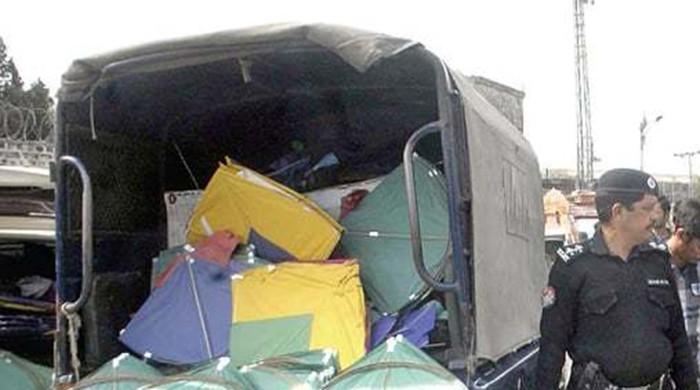
LAHORE: Over a hundred kite flyers were arrested in a crackdown operation on Sunday by the police and as many as ninety cases were registered.
Despite a ban on kite-flying in Lahore, and crackdown operation as recent as two weeks ago, some people still persisted with making and flying kites, while disobeying the law. 

Following an incident of a little girl getting injured due to kite string, SP Cantt Rana Tahir reported on a crackdown operation in Cantt Division.
In an operation lasting ten hours, the police seized around four thousand kites.
Earlier this month, IG Operations Lahore, Dr Haider Ashraf ordered a crackdown against the kite flyers. About 11 kite flyers were arrested from City Division, 17 from Cantt, 12 from Civil Lines, 4 from Saddar, 18 from Iqbal Town and 4 from Model Town. Police also seized around 500 kites, rolls and strings.

US stock futures fall after Trump immigration controversy

US stock futures fall after Trump immigration controversy
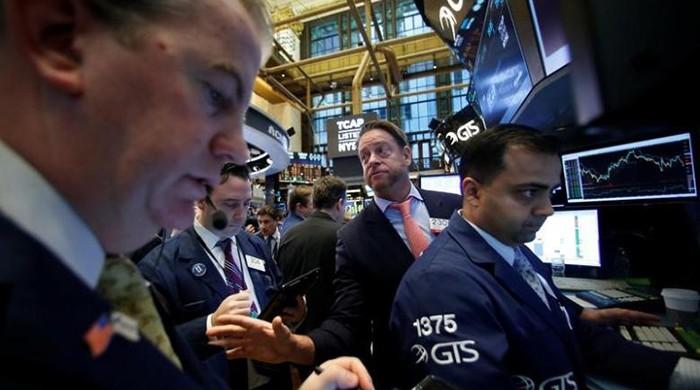
NEW YORK: US equity index futures opened down about 0.2 percent on Sunday after US President Donald Trump on Friday introduced immigration curbs that sparked a backlash in the United States and abroad.
Trump put a 120-day hold on allowing refugees into the country, an indefinite ban on refugees from Syria and a 90-day bar on citizens from Iran, Iraq, Libya, Somalia, Sudan, Syria and Yemen. Several countries including long-standing American allies criticised the measures as discriminatory and divisive.
"Stocks may react negatively for two reasons," said David Kotok, chairman and chief investment officer of Cumberland Advisors. "First the market has gone up strongly since the election. So it is ripe for a correction and is extended in valuation metrics."
"For these current market prices to be justified, the Trump agenda must unfold perfectly," Kotok said. "But the reverse is under way and fragmented policy combined with obfuscation is now a growing detriment to growth acceleration."
S&P e-mini futures < ESv1> were last down 0.3 percent as electronic trading kicked off for the week at 6 p.m. EST (2300 GMT). Dow 1YMc1 and Nasdaq futures NQc1 were also down about 0.2 percent each.
The weakness in stocks came as safe-haven Treasuries opened fractionally stronger. US 10-year Treasury futures TYv1 were last up about 0.01 percent on Sunday evening in electronic trading.
The US dollar weakened slightly against the euro and yen, and the US Dollar Index was lower by about 0.1 percent.
Oil prices also slipped at the open, with US crude oil futures CLc1 trading 0.4 percent lower.

Madrid extends La Liga lead as Barca, Sevilla slip-up

Madrid extends La Liga lead as Barca, Sevilla slip-up
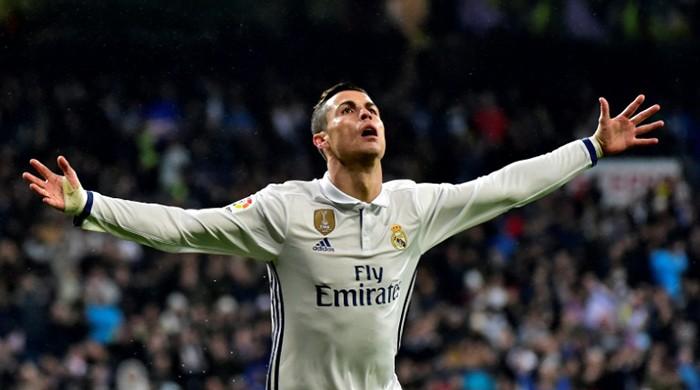
MADRID: Real Madrid extended their La Liga lead to four points and still have a game in hand over their title rivals as Cristiano Ronaldo was on target in a 3-0 win over Real Sociedad at the Santiago Bernabeu.
Earlier on Sunday, Barcelona were left to rue La Liga's lack of goal line technology as they weren't awarded a clear goal in a controversial 1-1 draw at Real Betis.
However, Barca still moved up to second on goal difference as Sevilla were reduced to 10 men after just two minutes in a 3-1 defeat at Espanyol.
Madrid had won only one of their previous five games and were dumped out of the Copa del Rey by Celta Vigo in midweek.
However, even without six first-team regulars through injury, Real took a huge step towards a first La Liga title for five years against an in-form Sociedad, who remain just one point off the top four in fifth.
"After a few difficult days we were back to being ourselves tonight. It was a complete performance against a strong opponent," said Real boss Zinedine Zidane.
"We can say it has been a good night for us because our rivals have drawn or lost."
Mateo Kovacic opened the scoring with the only real chance of the first-half as he timed his late run from midfield perfectly for Ronaldo's through ball and slotted low beyond Geronimo Rulli.
The roles were reversed six minutes into the second-half as this time Kovacic's pass split the Sociedad defence and Ronaldo coolly chipped the onrushing Rulli for his 20th goal of the season.
Sociedad's uphill task was made impossible 15 minutes from time when Inigo Martinez was sent-off for a second bookable offence.
And Alvaro Morata made the 10 men pay as he bulleted home Lucas Vazquez's cross for the third eight minutes from time.
'Metre over the line'
There was far more drama at the Benito Villamarin as Barca were largely outplayed by Betis, but still felt hard done by after referee Alejandro Jose Hernandez failed to award them an equaliser when the ball crossed the Betis line shortly after Alex Alegria's opener 15 minutes from time.
"We have to help the referees," Barca boss Luis Enrique told BeIN Sports Spain.
"The technology can help them. I say that for all situations not just ones that go for me, but against me too."
Luis Suarez did at least rescue a point in the dying seconds, though, as he slotted home Lionel Messi's through ball for his 21st goal of the season.
However, he was less understanding as he claimed the ball "was a metre over the line."
The hosts dominated opening 75 minutes as Dani Ceballos saw a dipping long-range effort come back off the bar before Ruben Castro struck the post with Marc-Andre ter Stegen beaten at his near post.
The German goalkeeper had a moment to forget for the opening goal as he failed to get a good connection on an attempted punch under pressure from two Betis players and the ball fell kindly for Alegria to tap home.
Conceding appeared to wake Barca from their slumber and they were doubly denied by Hernandez seconds later as Neymar went down inside the area and the ball ricocheted off Riza Durmisi and over his own line despite Alissa Mandi's best efforts.
Yet, La Liga's refusal to implement goal line technology due to pricing fears cost Barca dearly as no goal was given.
Betis should have sealed the three points when Castro broke clear on goal eight minutes from time, but Ter Stegen redeemed himself with a fine save.
And that miss proved crucial as Messi finally found the space to slip a pass through the Betis defence and Suarez dispatched the ball into the far corner.
"The feeling I have is that we have won one point (not lost two)," added Enrique.
There was also refereeing controversy at Espanyol as Sevilla's shot at moving top lasted barely two minutes when Nico Pareja was very harshly sent-off on top of conceding a penalty for a trip on Pablo Piatti.
Former Sevilla favourite Jose Antonio Reyes showed no mercy to his former club as he converted from the spot, but Stefan Jovetic levelled for the 10 men inside 20 minutes.
Reyes haunted Sevilla once more as his free-kick was headed home by Marc Navarro in first-half stoppage time.
And Gerard Moreno sealed the three points for Espanyol as this time Navarro was the supplier for his headed finish.

Shyamalan's 'Split' rules North American box office for second week

Shyamalan's 'Split' rules North American box office for second week

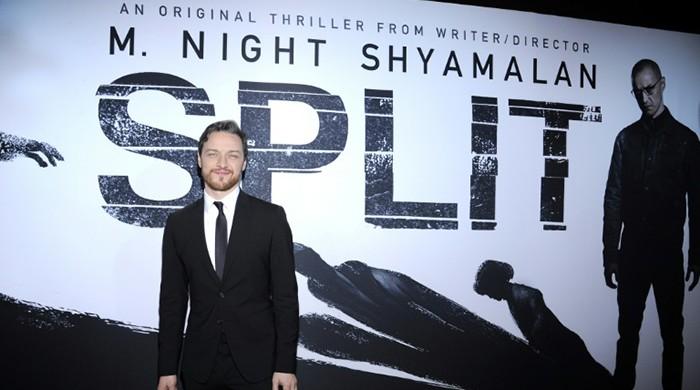
LOS ANGELES: "Split," the latest M. Night Shyamalan thriller about a man who imprisons three teenage girls in an underground bunker, topped the North American box office for a second week, preliminary Hollywood figures showed Sunday.

The movie -- by the Indian-American director also responsible for the "Sixth Sense" and other films in the horror genre -- stars James McAvoy as a man with 23 different personalities who preys on three girls. It earned $26.3 million in estimated ticket sales this weekend.
Family-friendly "A Dog's Purpose" about a canine who continually comes back to life as different dogs searching for meaning, raked in some $18.4 million in its first week.
The film came in second despite a call by animal lovers for a boycott after video footage emerged of an apparently terrified German Shepherd being forced into rushing water on the set.
Third place went to "Hidden Figures," the true-life story of three black women mathematicians who helped NASA put the first men in space, which sold $14.0 million in tickets.
Sci-fi action-thriller "Resident Evil: The Final Chapter" landed in fourth place with $13.9 million in its first weekend out.
In fifth place was "La La Land," a nostalgic tribute to the Golden Age of Hollywood musicals. It earned an estimated $12.1 million over the weekend after garnering a boatload of accolades, including a record eight Golden Globes earlier this month.
Rounding out the Top 10 are:
"xXx: Return of Xander Cage" ($8.3 million)
"Sing" ($6.2 million)
"Rogue One: A Star Wars Story" ($5.1 million)
"Monster Trucks" ($4.1 million)
"Gold" ($3.5 million)

Macedonians send out SOS from Europe's oldest lake

Macedonians send out SOS from Europe's oldest lake
A fishing boat glides across the shimmering surface of Europe's oldest lake, a haven of biodiversity and a UNESCO World Heritage Site -- one that conservationists warn faces multiple development threats.

Lake Ohrid, which straddles the mountainous border of Macedonia and Albania, has been in existence for up to three million years and is home to more than 200 species of flora and fauna found nowhere else in the world.
But huge infrastructure plans on the Macedonian side have alarmed environmentalists and the United Nation's cultural agency UNESCO, which has called on the country's authorities for an urgent assessment of the potential cumulative damage.
The proposals include a large ski complex and an expressway through the lakeside Galicica National Park, itself a protected area home to thousands of plant and animal species.
Local activists are also incensed by proposed "touristic development zones" and other urbanisation plans on Ohrid's shores, including a marina and apartment buildings.
They fear the destruction of a 50-hectare (120-acre) wetland serving as a crucial natural filter to the lake, pointing to a draft impact assessment, commissioned by the local government, that warns of unavoidable damage.
Officials insist they will protect Ohrid's heritage, but campaigners accuse them of manipulation and violating laws to allow such developments to go ahead.
The "tsunami" of planned infrastructure projects, if implemented, "means that you can just say goodbye to the UNESCO World Heritage Site," said Aleksandra Bujaroska, an environmental lawyer in the Balkan country.
Bujaroska is part of the citizens' association Front 21/42, which is campaigning for a moratorium on all of the "destructive" plans.
"The big issue with all of these procedures... is the constant breach of public participation," said the 30-year-old lawyer, who grew up in Ohrid and is based in the capital Skopje.
Byzantine beauty
UNESCO has assigned World Heritage status to more than 1,000 sites in the world, but fewer than three dozen are listed as both "natural" and "cultural" sites. The Ohrid region is one of them.
On the lake's Macedonian shores, the city of Ohrid is one of Europe's oldest human settlements with a wealth of Byzantine-style icons, frescoes and churches, which together with the lake's natural beauty drew more than 200,000 tourists last year.
"It's amazing. The beautiful thing is it's so close to nature," said visiting Polish student Aleksandra Walerych by the 13th-century Church of St John at Kaneo, which overlooks the lake and is thought to be the most photographed spot in the country.
The lake covers an area of 358 square kilometres (143 square miles), two-thirds of which lie in Macedonia and are covered by the World Heritage status and work is under way to try to extend this to the third lying in Albanian territory too.
But at its annual meeting in Istanbul in July last year, the UNESCO World Heritage Committee said it "notes with concern that a number of large-scale infrastructure projects have been proposed" on the Macedonian side.
It warned that Ohrid could find itself on the "List of World Heritage in Danger" if threats to the site were confirmed, suggesting alternative routes and locations should be identified for major projects.
Sites can lose their heritage status if they are deemed to be improperly protected.
Alexandra Fiebig, project officer for Europe and North America at UNESCO's World Heritage Centre, told AFP there had been "a lot of close contact with the (Macedonian) authorities" and a UNESCO "reactive monitoring mission" was due to start work in Ohrid soon.
'Political agendas'
Of the raft of controversial proposals, expected to involve both private and public investment, some fall under the remit of central government ministries while others are part of municipal plans.
The European Bank for Reconstruction and Development, a potential investor in the expressway, says it is "assessing the feasibility" of the project.
Macedonia's conservative VMRO-DPMNE party, in power nationally since 2006, has been accused by critics of authoritarianism and corruption but narrowly won a general election in December.
Ohrid's mayor Nikola Bakraceski, from VMRO-DPMNE, insists environmental regulations have been followed and the public sufficiently consulted in city planning. He accuses activists of having "political agendas" and lacking expertise.

THIS DAY IN HISTORY

On January 29, 1936, the U.S. Baseball Hall of Fame elects its first members in Cooperstown, New York: Ty Cobb, Babe Ruth, Honus Wagner, Christy Matthewson and Walter Johnson.

The Hall of Fame actually had its beginnings in 1935, when plans were made to build a museum devoted to baseball and its 100-year history. A private organization based in Cooperstown called the Clark Foundation thought that establishing the Baseball Hall of Fame in their city would help to reinvigorate the area’s Depression-ravaged economy by attracting tourists. To help sell the idea, the foundation advanced the idea that U.S. Civil War hero Abner Doubleday invented baseball in Cooperstown. The story proved to be phony, but baseball officials, eager to capitalize on the marketing and publicity potential of a museum to honor the game’s greats, gave their support to the project anyway.

In preparation for the dedication of the Hall of Fame in 1939–thought by many to be the centennial of baseball–the Baseball Writers’ Association of America chose the five greatest superstars of the game as the first class to be inducted: Ty Cobb was the most productive hitter in history; Babe Ruth was both an ace pitcher and the greatest home-run hitter to play the game; Honus Wagner was a versatile star shortstop and batting champion; Christy Matthewson had more wins than any pitcher in National League history; and Walter Johnson was considered one of the most powerful pitchers to ever have taken the mound.

Today, with approximately 350,000 visitors per year, the Hall of Fame continues to be the hub of all things baseball. It has elected 278 individuals, in all, including 225 players, 17 managers, 8 umpires and 28 executives and pioneers.

Friday, 27 January 2017

Box Office: Raees Vs Dangal. Who grossed more at the North America box office on Day 1?

Raees-Dangal
Shah Rukh Khan has always enjoyed a massive fan following across the seas. Now, unlike the conventional release pattern that sees Bollywood films releasing a day earlier in the overseas markets, the Rahul Dholakia directed film Raees starring Shah Rukh Khan saw a simultaneous release in both the overseas and domestic markets.
The much awaited and talked about Aamir Khan starrer Dangal released last year. Based on the life of wrestler and coach Mahavir Singh Phogat, Dangal released across 1000 screens in overseas from which the North American, UAE/ GCC, UK and Australia circuits saw the widest release.
The Day 1 comparison between Raees and Dangal are as follows
U.S.A box office
Raees – 274,603 USD [Rs. 1.87 cr.] from 223 screens
Dangal – 686,031 USD [Rs. 4.61 cr.] from 280 screens (Includes paid previews)
Canada box office
Raees – 73,372 USD [Rs. 49.95 lacs] from 24 screens
Dangal – 100,189 USD [Rs. 67.95 lacs] from 24 screens (Includes paid previews)
Day 1 comparison minus paid previews of Dangal
U.S.A box office
Raees – 274,603 USD [Rs. 1.87 cr.] from 223 screens
Dangal – 403,751 USD [Rs. 2.75 cr.] from 280 screens

Canada box office

Raees – 73,372 USD [Rs. 49.95 lacs] from 24 screens
Dangal – 57,373 USD [Rs. 39.07 lacs] from 24 screens
- See more at: http://www.bollywoodhungama.com/news/box-office-special-features/box-office-raees-vs-dangal-grossed-north-america-box-office-day-1/#sthash.iDVwitt8.dpuf

xXx: Return of Xander Cage Poster


Storyline

Extreme athlete turned government operative Xander Cage (Vin Diesel) comes out of self-imposed exile, thought to be long dead, and is set on a collision course with deadly alpha warrior Xiang (Donnie Yen) and his team in a race to recover a sinister and seemingly unstoppable weapon known as Pandora's Box. Recruiting an all-new group of thrill-seeking cohorts, Xander finds himself enmeshed in a deadly conspiracy that points to collusion at the highest levels of world governments. Written by Ohad Gabay
Plot Summary | Plot Synopsis

Plot Keywords:

 parachute | free fall | airplane | tattoo | swimming pool | See All (25) »

Taglines:

 There are no more patriots, just rebels and tyrants. See more »

Genres:

 Action | Adventure | Thriller

Motion Picture Rating (MPAA)

Rated PG-13 for extended sequences of gunplay and violent action, and for sexual material and language | See all certifications »

Parents Guide:

  »
Edit

Details

Official Sites:

  | 

Country:


Language:


Release Date:

 20 January 2017 (USA)  »

Also Known As:

 Xander Returns  »

Filming Locations:

   »

Box Office

Budget:

 $85,000,000 (estimated)

Opening Weekend:

 $20,130,142 (USA) (20 January 2017)

Gross:

 $24,308,024 (USA) (25 January 2017)
 »

Company Credits

Show detailed  on  »

Technical Specs

Runtime:


Color:


Aspect Ratio:

 2.35 : 1
See  »
Edit

Did You Know?

Trivia

Film debut of football player NeymarSee more »

Quotes

Darius Stone: X looks out for his own.
See more »

Connections

References xXx: State of the Union (2005) See more »

Soundtracks

Burning Man
Written by Andrew Wotman, Austin Richard Post, Brian Lee, Ben Diehl & Louis Bell
Performed by Andrew Watt featuring Post Malone
Courtesy of Republic Records under license from Universal Music Enterprises

Raees Box Office


Superstar Shah Rukh Khan's Raees is unstoppable at the box office. The film made Rs 46.72 crore by the end of second day of its release, reported trade analyst Taran Adarsh. ... Raees made a whopping 20.42 crore on Day 1 while Hrithik Roshan's Kaabil, which releases on the same day made Rs 10.43 crore on the same day.16 hours ago

4 ways China could deal with Donald Trump

Hong Kong (CNN)President Donald Trump has wasted no time getting down to business as US commander in chief, but few countries in the world will be watching his moves as closely as China.
Since his election in November, President Trump has challenged Beijing over its military build-up in the South China Sea, slammed its currency and trade policies and, perhaps most controversially, upended decades of diplomatic protocol by questioning a longstanding US policy towards Taiwan.
He's also handed key jobs to people with controversial views on China, not least his choice for Secretary of State Rex Tillerson, who has suggested that Beijing be blocked from accessing its artificial islands.
    The leaders in Zhongnanhai, the gated compound that is China's equivalent to the White House, want to know how seriously they should take such statements. Will they translate into policy? And within Trump's inner circle, whose voice will prevail?
    "They (China's leaders) might be willing to give up something but if Trump asks too much, China is willing to fight," says Zhang Baohui, a professor of political science at Lingnan University,
    Here's four ways China could try to handle the Oval Office's unpredictable new occupant.

    1. Play the long game

    Trump's bluster could be just that. There's a long history of US presidents taking a tough stance on China only to moderate it once in office.
    President George W. Bush came to power vowing to treat China as a "strategic competitor" only to default to engagement. President Ronald Reagan said he would cut off diplomatic links with Beijing. Two years after he was elected, he visited China.
    Jon Huntsman Jr., a former US ambassador to Beijing, says Trump's fiery talk on China fits that pattern.
    "This is kind of a replay of what we've seen before. Trump at some point is going to have to say 'I've gotta sit down and do business with the Chinese," he told CNN.

    China and the U.S. in the next four years 03:12
    Trump has already moderated one of his key stances on China. In an interview with the Wall Street Journal, he walked back on an earlier pledge to name China a currency manipulator on day one of his administration.
    However, analysts say this strategy is risky for China. If President Xi Jinping stays too quiet in the face of Trump's provocations, it makes Xi, who has built his credibility on being a strong leader, look weak.
    This could trigger protests --- something Xi is unlikely to want in a year that will also see some leadership changes in Beijing when the Chinese Communist Party holds its once-every-five-years congress.
    "Xi definitely doesn't want relations with the US to stir up trouble. He's anxious not to allow nationalistic young men and women to demonstrate against the US," says Willy Lam, an adjunct professor at the Centre for Chinese Studies at the Chinese University of Hong Kong.

    2. Cozy up and negotiate

    Many Chinese observers stress Trump's background as a business man and believe hisposturing over Taiwan and the South China Sea is simply an opening gambit in advance of real business negotiations.
    "I don't think Trump and his team will carry out the bulk of their threats," says Lam.
    "We need to remember that Trump is a shrewd businessman. He's raising an extreme position from which he might do a bit of climbing down if the Chinese were amenable to making other compromises."
    China has been busy behind the scenes reaching out to people close to Trump, says Zhang Baohui, a professor of political science at Lingnan University,
    "They will first try and shape his China policy by trying to work with him," says Zhang.
    "They've floated the idea of trying to invest in US infrastructure. The Chinese fundamentally think he is a businessman who wants to create jobs -- even if he's willing to play dirty tricks over things like Taiwan."
    It's a strategy that's worked well elsewhere for Beijing, with China building and forginginfrastructure deals in Africa, Eastern Europe and southeast Asia.

    3. Get personal

    Personalities count, especially in China where connections or guanxi are viewed as key to getting anything done.
    Zhang says that many in China want a meeting between Trump and Xi as soon as possible, with some suggestion that Trump could be invited to a multilateral meeting on China's "one belt, one road" initiative in May.
    Another opportunity would come in July when the G20 meeting is held in Germany or November when Vietnam hosts APEC -- the Asia Pacific Economic Cooperation summit.
    "When they meet directly and have glass of Maotai together over dinner, Xi could disarm Trump. He's a good diplomat," says Zhang, referring to a popular Chinese liquor.
    China may also use Trump's pick for US ambassador to Beijing, Iowa governor Terry Branstad, to cement ties between Xi and Trump.
    Branstad and Xi have known each other since 1985, when Xi visited Iowa as a provincial official on a state exchange program during Branstad's first term as governor, and have maintained a friendship of sorts.

    4. Make Trump's life difficult

    Of course, China could make life difficult for Trump if it wants to. Lam at the Chinese University of Hong Kong says China is already quietly preparing for a trade war.
    "The Chinese commerce department has drawn up a meticulous list of possible retaliatory measures -- which US companies would be hit with what kind of tariffs should the US (fire) a salvo in a trade war," he says.
    It's not something to take lightly, especially for a US president who's staked his legitimacy on delivering jobs and an economic revival, says Jing Ulrich, Managing Director and Vice Chairman of Asia Pacific, JPMorgan Chase.
    "Remember Boeing has projected selling in the next 20 years $1 trillion worth of aircraft into China. If tariffs were put on that would be very damning to an iconic US company. And that's just one example," she says.
    China could hit back in other ways. It could choose to squeeze Taiwan economically, become more aggressive in the South China Sea or shore up its ties with North Korea.
    Shen Dingli, a professor of International Relations at Fudan University in Shanghai, says he believes that China is willing to negotiate with the US and the two should be able to resolve their differences on trade -- but Taiwan is a red line for China's leaders.
    "We cannot do Taiwan as a bargaining chip," he says.
    "If Trump still plays the Taiwan card then China and the US would have a very serious confrontation. This is hopefully not what Trump wants to have."